I have spent a good deal of time the last 14 years hanging out with neo-Pagans of all sorts: Witches, Druids, Shamans, and others. They are my friends. This is not just some kind of engagement of an evangelical sort, but a deeper relationship of real friendships and respect.
As a Christian pastor this has required me to think about the depth of my interaction with other religious traditions.
The Apostle Paul wrote about handling the subject of being offered a meal when the food was offered to idols first. He navigated the tricky decision of remaining faithful to God, and not trying not to offend those who offered the meal. He seems to indicate that he would eat without reservation as long as it did not require allegiance to other gods, or appear to make others believe that he had given his allegiance over to other gods.
This has become my basic line of engagement with other religions. I will participate with them in activities which do not involve crossing a line of allegiance away from Jesus, or to another god or goddess. In this way, I can be involved with people of other religions without changing my own religion. Paul must have had to act this same way many times as he navigated ministry in the Roman Pagan world.
When you are with your friends who are involved with a spiritual path which is very much unlike your own, how do you respond to times when their religion is being practiced? Do you avoid those moments? Get involved? or simply watch from a distance? and where do you draw your lines of engagement?
Showing posts with label shamanism. Show all posts
Showing posts with label shamanism. Show all posts
Tuesday, October 11, 2011


Tuesday, March 09, 2010
Jesus as the Archetype Shaman (Part 4c): extended journey and communication with spirits

The story of the the death and resurrection of Jesus covers a three day period. In this three day period tradition and Biblical narrative relate to a soul journey by the man in the tomb of Gethsemane: a journey which would take him on a visit to the souls of other departed individuals and a return to life in triumph over death itself.
This journey into death, which appeared to be a hopeless end to a powerfully lived life would become the ultimate statement of his power. Like the initiatory trances, sicknesses, and journeys by many Shamans in many cultures, the journey of Jesus into death is a crisis, which necessitated a return as proof of his power.
This man went to Pilate and asked for the body of Jesus. Then Pilate commanded the body to be given to him. When Joseph had taken the body, he wrapped it in a clean linen cloth, and laid it in his new tomb which he had hewn out of the rock; and he rolled a large stone against the door of the tomb, and departed. And Mary Magdalene was there, and the other Mary, sitting opposite the tomb.
On the next day, which followed the Day of Preparation, the chief priests and Pharisees gathered together to Pilate, saying, "Sir, we remember, while He was still alive, how that deceiver said, 'After three days I will rise.'
"Therefore command that the tomb be made secure until the third day, lest His disciples come by night and steal Him away, and say to the people, 'He has risen from the dead.' So the last deception will be worse than the first."
Pilate said to them, "You have a guard; go your way, make it as secure as you know how." So they went and made the tomb secure, sealing the stone and setting the guard.
This three day period is reflected upon by the Apostle Peter who gives insight to the soul travels of Jesus with these words, >I>"For Christ also suffered once for sins, the just for the unjust, that He might bring us to God, being put to death in the flesh but made alive by the Spirit, by whom also He went and preached to the spirits in prison, who formerly were disobedient...."
The journeys of Shamans in a variety of folk traditions from Siberia to South America relate of dangerous trance journeys into the underworld. Communication with spirits is a regular aspect of these travels. We find this motif being reiterated in the death and resurrection of Christ.
For three days Jesus is faced with humanity's greatest enemy - death itself, and according to narrative laid out in Christian tradition, Jesus communicates with the dead, and returns from the grave. In this we see once again that Christ could easily be seen as an archetype Shaman. His communication with spirits of the dead, and his return to life from death become a literal fulfillment of that which is experienced only in traces by Shamans of tribes across the world.
This is a continuation of thoughts on Jesus as the archetype Shaman. Previous posts relating to this topic can be found below:
Part 1 of the series
Part 2 of the series
Part 3 (thoughts on shamanism and glossalalia as it relates to Christians)
Part 4a of the series
Part 4b Descent by crisis or struggle
Passages above come from these Biblical passages and are from the New King James version:
descent for days/ extended journey (Mt. 27:62-28:6)
descent and communication with spirits (1 Peter 3:18-19)
Thursday, December 31, 2009
Jesus as the Archetype Shaman (Part 4b): Descent by crisis or struggle
This particular series was begun under the assumption that God has spoken and is speaking into all cultures of people. Could it be that ancient (and even more recent) shaman are experiencing God dynamics? If so, is it also possible that Christ models the search, the experiences, and the utopian hopes wrapped up in the vocation of the shaman?

Now from the sixth hour until the ninth hour there was darkness over all the land. And about the ninth hour Jesus cried out with a loud voice, saying, "Eli, Eli, lama sabachthani?" that is, "My God, My God, why have You forsaken Me?" Some of those who stood there, when they heard that, said, "This Man is calling for Elijah!" Immediately one of them ran and took a sponge, filled it with sour wine and put it on a reed, and offered it to Him to drink. The rest said, "Let Him alone; let us see if Elijah will come to save Him." And Jesus cried out again with a loud voice, and yielded up His spirit. (Mt. 27:45-50)
In the case studies of shamanic trance travels there is an oft repeated theme of crisis and shamanic travel being combined. In some cases this crisis accompanies an initial journey which beckons a neophyte into a lifetime calling of service to others as a shaman or medicine man. In other cases danger is part of the trance journey, and challenges the shaman even before he completes a descent into the under/other world.
Black Elk's initiation into his life as an Oglala Sioux Medicine Man outlines a 12 day struggle with sickness when he was a young man. For those 12 days he laid sick in his parent's teepee. In his dreams, or in trance-like state Black Elk traveled to distant places, and heard sacred things. Upon his recovery the medicine man who was credited with healing him declared that he had a special thing to do in his life, because he was "sitting in the sacred manner."
Black Elk would go on to serve as a Holy Man for nearly 50 years. During his time he joined a Messianic movement called the "Ghost Dancers," and became a Christian who served God and his tribe in a uniquely native American manner, which included dreams and trances with messianic visions.
The Altaic shamans speak of underworld journeys with dangerous bridges to be crossed on path down, and visions of shamans trapped in the underworld who could not make it because they were sinners. Evil beasts are met on the path, and must be fought or avoided. These stories retold in Eliade's book Shamanism underscore a oft repeating motif in shamanic underworld journey: It is frequently met with difficulty.
Jesus' entrance to the underworld began in the greatest of human struggles: death, and not any death, but a violent, tortuous death met at the painful hands of betrayal. His journey, which would end up victorious begins on this deadly note, and appears to have no hope for redemption.
Part 1 of the series
Part 2 of the series
Part 3 (thoughts on shamanism and glossalalia as it relates to Christians)
Part 4a of the series

In the case studies of shamanic trance travels there is an oft repeated theme of crisis and shamanic travel being combined. In some cases this crisis accompanies an initial journey which beckons a neophyte into a lifetime calling of service to others as a shaman or medicine man. In other cases danger is part of the trance journey, and challenges the shaman even before he completes a descent into the under/other world.
Black Elk's initiation into his life as an Oglala Sioux Medicine Man outlines a 12 day struggle with sickness when he was a young man. For those 12 days he laid sick in his parent's teepee. In his dreams, or in trance-like state Black Elk traveled to distant places, and heard sacred things. Upon his recovery the medicine man who was credited with healing him declared that he had a special thing to do in his life, because he was "sitting in the sacred manner."
Black Elk would go on to serve as a Holy Man for nearly 50 years. During his time he joined a Messianic movement called the "Ghost Dancers," and became a Christian who served God and his tribe in a uniquely native American manner, which included dreams and trances with messianic visions.
The Altaic shamans speak of underworld journeys with dangerous bridges to be crossed on path down, and visions of shamans trapped in the underworld who could not make it because they were sinners. Evil beasts are met on the path, and must be fought or avoided. These stories retold in Eliade's book Shamanism underscore a oft repeating motif in shamanic underworld journey: It is frequently met with difficulty.
Jesus' entrance to the underworld began in the greatest of human struggles: death, and not any death, but a violent, tortuous death met at the painful hands of betrayal. His journey, which would end up victorious begins on this deadly note, and appears to have no hope for redemption.
Part 1 of the series
Part 2 of the series
Part 3 (thoughts on shamanism and glossalalia as it relates to Christians)
Part 4a of the series
Monday, December 28, 2009
Jesus as the Archetype Shaman (Part 4a): Descent into the Underworld, entrance through a hole in the earth
Click on this image for a full map of Dante's Inferno.
"Now you are ready for your first experiential exercise in shamanism. This will be a simple journey of exploration through the Tunnel into the Lowerworld." These are the words of Michael Harner in his book The Way of the Shaman released in 1980.
Travels into the underworld were identified in Eliade's classic study of Shamanism as a regularly identifiable aspect of the practices of many shamans in many cultures. Michael Harner considers this a beginning point of learning the arts of his brand of neo-shamanism.
Eliade noted that among the Tungus the younger, newer shamans were denigrated as cowards, because many no longer took the difficult journey to the Underworld. (Shamanism: 237) Eliade's recounting of an Altaic shaman's descent in the underworld is not unlike portions of Dante's Inferno. This underworld journey is filled with challenges and tests.
In a universe which is often (but certainly not always) viewed as consisting of the three categories of the heavens, the earth, and the underworld, the shaman takes the challenge of navigating the realms unseen by others for their benefit.
This particular element of shamanism is perhaps the most dramatic illustration of Jesus as the Archetypal Shaman. His death, burial, descent into Hell, and resurrection in victory is the physical/literal accomplishment of a shamanic underworld journey. The various elements of underworld journey as they are practiced across the shamanic cultures of the world appear to be fulfilled in the journey of Jesus.
This section has taken a bit more thought, and preparation than I might have anticipated initially, and so I tread this ground carefully, but I do so with a larger vision of the capacities of Jesus than I might have presented had I simply approached this as a minor exercise in anthropological missiology.
Here begins my consideration of Jesus' descent into Hell, and the place it holds in fulfilling the needs of humanity, and myths of shamanic cultures across the world.
Descent through hole in the earth (Mt. 27:57-60)
The story of Christ's descent in the Underworld begins with his burial in the cave tomb provided by Joseph of Arimithea. Holes in the ground, hollow trees, oceans, and entrances to underground rivers have been used by shamanic trance travelers as entry points into the underworld.
Christ's burial in the cave tomb has a similar point of initiatory dynamic as entering hole in the ground, or the hollow of a tree. It mimics an entry point to the underworld. Once the stone was rolled in place, Christ was sealed to the fate of his underworld journey, which to a wondering world appeared to be a permanent unconditional journey. Through His spiritual authority this was not to be a final journey to death and afterlife, but a powerful expression of his conquest over the underworld.
Mircea Eliade's book Shamanism: Archaic Techniques of Ecstasy describes the ritual descent into the underworld by an Altaic Shaman. This ritual was observed by an orthodox priest who had attended and chanted at a number of these rituals in his youth. After the Shaman journeys across land, and climbs a mountain in his trace, he then is taken to a hole in the side of the mountain which leads him to the underworld - to face trials and a difficult journey before a successful return.
The journey of Christ into the underworld likewise began in an entrance upon the face of the earth. Joseph of Arimathea asked for the body of Christ to be given to him, and then with Nicodemus took the body to a new tomb, and placed the stone over the grave. This began Jesus' journey to the underworld. He began it as a dead man, and would return in archetypal shamanistic fashion three days later as master over life and death.
more to come...this is the first section of part 4 in the series on Jesus as the Archetypal Shaman. There are likely to be half a dozen sections to this part alone.
Part 1 of the series
Part 2 of the series
Part 3 (thoughts on shamanism and glossalalia as it relates to Christians)

"Now you are ready for your first experiential exercise in shamanism. This will be a simple journey of exploration through the Tunnel into the Lowerworld." These are the words of Michael Harner in his book The Way of the Shaman released in 1980.
Travels into the underworld were identified in Eliade's classic study of Shamanism as a regularly identifiable aspect of the practices of many shamans in many cultures. Michael Harner considers this a beginning point of learning the arts of his brand of neo-shamanism.
Eliade noted that among the Tungus the younger, newer shamans were denigrated as cowards, because many no longer took the difficult journey to the Underworld. (Shamanism: 237) Eliade's recounting of an Altaic shaman's descent in the underworld is not unlike portions of Dante's Inferno. This underworld journey is filled with challenges and tests.
In a universe which is often (but certainly not always) viewed as consisting of the three categories of the heavens, the earth, and the underworld, the shaman takes the challenge of navigating the realms unseen by others for their benefit.
This particular element of shamanism is perhaps the most dramatic illustration of Jesus as the Archetypal Shaman. His death, burial, descent into Hell, and resurrection in victory is the physical/literal accomplishment of a shamanic underworld journey. The various elements of underworld journey as they are practiced across the shamanic cultures of the world appear to be fulfilled in the journey of Jesus.
This section has taken a bit more thought, and preparation than I might have anticipated initially, and so I tread this ground carefully, but I do so with a larger vision of the capacities of Jesus than I might have presented had I simply approached this as a minor exercise in anthropological missiology.
Here begins my consideration of Jesus' descent into Hell, and the place it holds in fulfilling the needs of humanity, and myths of shamanic cultures across the world.
Descent through hole in the earth (Mt. 27:57-60)
The story of Christ's descent in the Underworld begins with his burial in the cave tomb provided by Joseph of Arimithea. Holes in the ground, hollow trees, oceans, and entrances to underground rivers have been used by shamanic trance travelers as entry points into the underworld.
Christ's burial in the cave tomb has a similar point of initiatory dynamic as entering hole in the ground, or the hollow of a tree. It mimics an entry point to the underworld. Once the stone was rolled in place, Christ was sealed to the fate of his underworld journey, which to a wondering world appeared to be a permanent unconditional journey. Through His spiritual authority this was not to be a final journey to death and afterlife, but a powerful expression of his conquest over the underworld.
Mircea Eliade's book Shamanism: Archaic Techniques of Ecstasy
describes the ritual descent into the underworld by an Altaic Shaman. This ritual was observed by an orthodox priest who had attended and chanted at a number of these rituals in his youth. After the Shaman journeys across land, and climbs a mountain in his trace, he then is taken to a hole in the side of the mountain which leads him to the underworld - to face trials and a difficult journey before a successful return.The journey of Christ into the underworld likewise began in an entrance upon the face of the earth. Joseph of Arimathea asked for the body of Christ to be given to him, and then with Nicodemus took the body to a new tomb, and placed the stone over the grave. This began Jesus' journey to the underworld. He began it as a dead man, and would return in archetypal shamanistic fashion three days later as master over life and death.
more to come...this is the first section of part 4 in the series on Jesus as the Archetypal Shaman. There are likely to be half a dozen sections to this part alone.
Part 1 of the series
Part 2 of the series
Part 3 (thoughts on shamanism and glossalalia as it relates to Christians)
Tuesday, May 19, 2009
Jesus as the Archetype Shaman (Part 2): A Nostalgia for Paradise
This is part of May's SynchroBlog on the Kingdom of God. See the bottom for links to other posts.
 As noted in my distantly past, last (and first) post on this topic, I believe that Jesus answers the haunting nostalgia for paradise, which follows the stories and myths of many shamanic cultures. This is not only a facet of the shamanic myths and their cultures, but also the leaning of Christianity as it hails back to the garden of Eden, and more often to the early and ancient church.
Yet shamanic culture and Christianity are not the only religious cultures to follow this primal call for paradise. Neo-Paganism began in a similar revivalist vein hoping to restore ancient, magical, and simple practices of Paganism. These primeval ties which Neo-Paganism has to supposed ancient Paganism have often proven to be as illusive as Christianity's hope of restoring the early church. Yet, this urge for a pristine and paradisaical system of religious practice remains a basic ideal for the cultus and theology of many religious systems. Jehovah's Witnesses, Mormons, Muslims, and other religious groups which began with a revivalist or reconstructionist call draw human hearts with promises of better days.
Jesus arrived upon the human scene declaring that the Kingdom of God had come. His work of healing, casting out devils, and preaching of a better way of living spoke to the human nostalgia for paradise.
His actions evidenced a benevolent power from an unseen Father. Accessed by faith this power promised to be available at some level to all the followers of Christ. It was a promise of a religious system founded in a paradisaical Kingdom, which would invade those who followed it with goodness.
Like the Shaman who ecstatically travels the unseen realm to seek healing for the sick, or blessing for the crops Jesus sought to bring paradise to earth in small packages of blessing and healing. These blessings answered the cry of paradise even if only for a moment.
The imagery of shamanic cultures includes a Cosmic Mountain, and a World Tree according to Mircea Eliade. Both these symbols imagine ascent to the heavens, and descent back to the earth with the hope of discovering blessing and power from above to help those on earth. This ascension imagery is seen in the words of Christ, "you shall see the heavens open, and the angels of God ascending and descending upon the the Son of Man."
Answering the utopian urge is one of the purposes of the Shaman, and was clearly a functional and foundational element of the messianic work of Christ. His declaration that the Kingdom of God had come was a challenge to a status quo of human mediocrity, and to the hordes of religious systems which had proven themselves to be hopelessly distopian. This nostalgia for paradise is among one of the many points which causes me to view Jesus of Nazareth as the Archetype Shaman.
For more reading on the Kingdom of God SynchroBlog see the links below:
• Susan Barnes (Christian currently attending a Baptist church) of
Abooklook on My kingdom goes
• Timothy Victor (Christian) of Tim Victor's Musings on The
reign of Godde
• Ronald van der Bergh (Dutch Reformed) of Ronalds Footnotes on
Notes on "the Kingdom of God" in the New Testament
• Nic Paton (fundamentalist, charismatic, liberationist, apophatic,
heterodox) of soundandsilence on The "Kingdom": of God?
• Beth Patterson (Non churched follower of Christ) of Virtual Tea
House on What it's like rather than what it is
• Jeff Goins (Non-denominational Christian) of Pilgrimage of the
Heart on The Kingdom of God: Now and Not Yet
• Brian Riley (YWAMer type o' dude and Jesus kinda guy) from Charis Shalom on Multiple Bloggers on the Kingdom of God
• Liz Dyer (follower of Jesus) of Grace Rules on
The Kingdom of God is at Hand
• Matt Stone (Christian) of Glocal Christianity on
The Only Christian Nation is the Kingdom of God
• Andrew Hendrikse of Fake expression of the Unknown on
The Kingdom of God is...
• Phil Wyman (Non-denominational Christian) of Square No More on
Jesus as the Archetype Shaman (Part 2): A Nostalgia for
Paradise
• Stephen Hayes (Orthodox Christian) of Khanya on
Kingdom, power and glory
 As noted in my distantly past, last (and first) post on this topic, I believe that Jesus answers the haunting nostalgia for paradise, which follows the stories and myths of many shamanic cultures. This is not only a facet of the shamanic myths and their cultures, but also the leaning of Christianity as it hails back to the garden of Eden, and more often to the early and ancient church.
Yet shamanic culture and Christianity are not the only religious cultures to follow this primal call for paradise. Neo-Paganism began in a similar revivalist vein hoping to restore ancient, magical, and simple practices of Paganism. These primeval ties which Neo-Paganism has to supposed ancient Paganism have often proven to be as illusive as Christianity's hope of restoring the early church. Yet, this urge for a pristine and paradisaical system of religious practice remains a basic ideal for the cultus and theology of many religious systems. Jehovah's Witnesses, Mormons, Muslims, and other religious groups which began with a revivalist or reconstructionist call draw human hearts with promises of better days.
Jesus arrived upon the human scene declaring that the Kingdom of God had come. His work of healing, casting out devils, and preaching of a better way of living spoke to the human nostalgia for paradise.
His actions evidenced a benevolent power from an unseen Father. Accessed by faith this power promised to be available at some level to all the followers of Christ. It was a promise of a religious system founded in a paradisaical Kingdom, which would invade those who followed it with goodness.
Like the Shaman who ecstatically travels the unseen realm to seek healing for the sick, or blessing for the crops Jesus sought to bring paradise to earth in small packages of blessing and healing. These blessings answered the cry of paradise even if only for a moment.
The imagery of shamanic cultures includes a Cosmic Mountain, and a World Tree according to Mircea Eliade. Both these symbols imagine ascent to the heavens, and descent back to the earth with the hope of discovering blessing and power from above to help those on earth. This ascension imagery is seen in the words of Christ, "you shall see the heavens open, and the angels of God ascending and descending upon the the Son of Man."
Answering the utopian urge is one of the purposes of the Shaman, and was clearly a functional and foundational element of the messianic work of Christ. His declaration that the Kingdom of God had come was a challenge to a status quo of human mediocrity, and to the hordes of religious systems which had proven themselves to be hopelessly distopian. This nostalgia for paradise is among one of the many points which causes me to view Jesus of Nazareth as the Archetype Shaman.
For more reading on the Kingdom of God SynchroBlog see the links below:
• Susan Barnes (Christian currently attending a Baptist church) of
Abooklook on My kingdom goes
• Timothy Victor (Christian) of Tim Victor's Musings on The
reign of Godde
• Ronald van der Bergh (Dutch Reformed) of Ronalds Footnotes on
Notes on "the Kingdom of God" in the New Testament
• Nic Paton (fundamentalist, charismatic, liberationist, apophatic,
heterodox) of soundandsilence on The "Kingdom": of God?
• Beth Patterson (Non churched follower of Christ) of Virtual Tea
House on What it's like rather than what it is
• Jeff Goins (Non-denominational Christian) of Pilgrimage of the
Heart on The Kingdom of God: Now and Not Yet
• Brian Riley (YWAMer type o' dude and Jesus kinda guy) from Charis Shalom on Multiple Bloggers on the Kingdom of God
• Liz Dyer (follower of Jesus) of Grace Rules on
The Kingdom of God is at Hand
• Matt Stone (Christian) of Glocal Christianity on
The Only Christian Nation is the Kingdom of God
• Andrew Hendrikse of Fake expression of the Unknown on
The Kingdom of God is...
• Phil Wyman (Non-denominational Christian) of Square No More on
Jesus as the Archetype Shaman (Part 2): A Nostalgia for
Paradise
• Stephen Hayes (Orthodox Christian) of Khanya on
Kingdom, power and glory
Tuesday, December 02, 2008
Jesus as the Archetype Shaman (Part 1)
Ascent to the heavens, descent to the underworld, an experience of death and resurrection, acting as a psychopomp to the lost souls of dead humans, story-teller, cultural icon and outcast, healer, exorcist...these are the works, and the personal experiences of a Shaman.
These are also the things which set Christ apart as unique in human history. These are things of which He is an exemplary model, and humanity's ideal for spiritual excellence and success. These elements are identified by religious historians as the signs, and activities of a Shaman. It is the contention of this post (and any following posts on the subject) that the Nazarene was the ideal of shamanic power and practice, and therefore The Archetypal Shaman.
This concept is not a new one. Others such as Peiter Craffert, and John Pilch have already done studies along these lines. Their ideas have been considered revolutionary by some, and heretical by others. Both Craffert and Pilch have appeared to have cast Jesus as the Galilean Shaman, at the expense of the orthodox Christian position of Messiah, and resurrected Lord of Heaven and Earth.
In contrast I understand Jesus to be the Savior of all humanity by means of His death and resurrection, and the unique Son of God. My position here in this post, and those that might follow is that Jesus carries many characteristics of the ideal Shaman, and exemplifies the power aspects, and ecstatic experiences of shamanism. In a shamanistic culture Jesus would have been viewed as the greatest of all Shamans, and both previous and subsequent Shamans would be a viewed as a diminishing of shamanic power, but coming from Jewish culture he was obviously held as the greatest of all prophets (and even more than that) to those who would follow Him.
By saying this I am not saying that all Christian ministers should become shamans, nor am I saying that Jesus saw Himself as a Shaman. This is a simple presentation suggesting only that the things Jesus did are things shamans all over the world have attempted to do throughout history, and that Christ is the exemplar of the experiences of the Shaman, and the goals which the Shaman seeks to accomplish. Deeper concepts, and further conclusions, which the reader may come to are their own surmisings, and not those which I am presenting here.
The Shaman is a type of medicine man who works for the community to bring healing, and prosperity. He battles evil spirits seeking to trouble humanity. Usually through ecstatic experiences of trances and soul travel the Shaman will discover healing remedies known only to God, or the gods. The Shaman may also lead the souls of those who have died to paradise through the same ecstatic soul journeys.
Eliade Mircea's landmark book "Shamanism" published in 1951, held this as a central theme: That the diminished powers of shamans were an oft repeated mythos across the continents and islands in which elements of shamanism could be found. Somewhere in the stories of ancient shamans there was an archetypal shaman whose powers far exceeded those of more recent history.
The degradation of power and also of an open and clean communication with the unseen realm of gods, goddesses and spirits is a repeated theme in the mythic stories in shamanistic cultures. This mirrors the story of the Fall in scripture. Once humanity walked in complete confidence before God - without shame, and in open and direct communication with Him. The hunt for a return to paradise underlies the story of our Christian scripture, and underlies the traditional stories of shamanism as well, and so the worlds of shamanism and Christianity meet at a common place.
"More than once we have discerned in the shamanic experience a "nostalgia for paradise" that suggests one of the oldest types of Christian mystical experience." wrote Eliade in the epilogue of the English edition of his book.
I am convinced Jesus answers the "nostalgia for paradise," and by doing so becomes the archetype of the Shaman.
More to come. Follow me as I follow Christ through the world of Shamanism. ;-)
These are also the things which set Christ apart as unique in human history. These are things of which He is an exemplary model, and humanity's ideal for spiritual excellence and success. These elements are identified by religious historians as the signs, and activities of a Shaman. It is the contention of this post (and any following posts on the subject) that the Nazarene was the ideal of shamanic power and practice, and therefore The Archetypal Shaman.
This concept is not a new one. Others such as Peiter Craffert, and John Pilch have already done studies along these lines. Their ideas have been considered revolutionary by some, and heretical by others. Both Craffert and Pilch have appeared to have cast Jesus as the Galilean Shaman, at the expense of the orthodox Christian position of Messiah, and resurrected Lord of Heaven and Earth.
In contrast I understand Jesus to be the Savior of all humanity by means of His death and resurrection, and the unique Son of God. My position here in this post, and those that might follow is that Jesus carries many characteristics of the ideal Shaman, and exemplifies the power aspects, and ecstatic experiences of shamanism. In a shamanistic culture Jesus would have been viewed as the greatest of all Shamans, and both previous and subsequent Shamans would be a viewed as a diminishing of shamanic power, but coming from Jewish culture he was obviously held as the greatest of all prophets (and even more than that) to those who would follow Him.
By saying this I am not saying that all Christian ministers should become shamans, nor am I saying that Jesus saw Himself as a Shaman. This is a simple presentation suggesting only that the things Jesus did are things shamans all over the world have attempted to do throughout history, and that Christ is the exemplar of the experiences of the Shaman, and the goals which the Shaman seeks to accomplish. Deeper concepts, and further conclusions, which the reader may come to are their own surmisings, and not those which I am presenting here.
The Shaman is a type of medicine man who works for the community to bring healing, and prosperity. He battles evil spirits seeking to trouble humanity. Usually through ecstatic experiences of trances and soul travel the Shaman will discover healing remedies known only to God, or the gods. The Shaman may also lead the souls of those who have died to paradise through the same ecstatic soul journeys.
Eliade Mircea's landmark book "Shamanism" published in 1951, held this as a central theme: That the diminished powers of shamans were an oft repeated mythos across the continents and islands in which elements of shamanism could be found. Somewhere in the stories of ancient shamans there was an archetypal shaman whose powers far exceeded those of more recent history.
The degradation of power and also of an open and clean communication with the unseen realm of gods, goddesses and spirits is a repeated theme in the mythic stories in shamanistic cultures. This mirrors the story of the Fall in scripture. Once humanity walked in complete confidence before God - without shame, and in open and direct communication with Him. The hunt for a return to paradise underlies the story of our Christian scripture, and underlies the traditional stories of shamanism as well, and so the worlds of shamanism and Christianity meet at a common place.
"More than once we have discerned in the shamanic experience a "nostalgia for paradise" that suggests one of the oldest types of Christian mystical experience." wrote Eliade in the epilogue of the English edition of his book.
I am convinced Jesus answers the "nostalgia for paradise," and by doing so becomes the archetype of the Shaman.
More to come. Follow me as I follow Christ through the world of Shamanism. ;-)
Thursday, October 23, 2008
Glossalalia and The Sacred Language of the Shaman: Christians as Pre-Mortem Psychopomps
 Communication with the spirits beyond the curtain of our visible/audible/tangible world is a skill belonging to the most spiritual, and perhaps the most insane among us. Those who hear the voices of gods and goddesses, angels and demons, ancestors and ghosts have been revered, feared, and ridiculed through ages and cultures of human history.
These holy men and women appear to see and hear things the average person does not. Sometimes with the senses, sometimes beyond their senses they experience a tie to a realm invisible to human eyes, and inaudible to human ears.
What distinguished these holy people from the common public was not only having ears and eyes, which perceive things most people do not, but even their speech hearkened the unseen realm. These mystics of the other world spoke the language of the spirits, and their communication traveled in both directions. They heard the secrets of the heaven and hell, and somehow spoke the secrets in languages unknown to the uninitiated.
During the initiation of a Shaman, he/she often must learn a new language. It is a language of the spirits - sometimes a language of the earth's creatures. Especially common among the Northern Asian, and Arctic Shamans this secret language was also found among Shamans of Sumatra, Borneo, South America, North America, and Guiana.
The ability to communicate with spirits and animals set the Shaman apart from others, and gave evidence to the ecstatic, and supernatural component of his or her healing and blessing activities.
The Shaman is a psychopomp. Lost postmortem souls are supposed to be led by the Shaman to their place of rest. The fact that the shamans communicate with the unseen realm is evidence to the uninitiated that they truly walk in the unseen world - the place to which our souls travel after death, and therefore know the paths of death which the uninitiated are forced to someday travel alone.
I am a Pentecostal/Charismatic Christian, and I find that there is a connection to these shamanic languages within my own faith. I speak the languages of angels, and men - languages which I have not learned through education, but which have spontaneously flowed from my tongue in times of worship and prayer.
Could it be that Charismatic Christians have become secret speakers who like the shaman speak the languages of men and angels, and declare divine mysteries hidden in the dark recesses of human history?
The shaman was required to communicate in the secret language of the spirits, and as such it was evidence that he held special communication with the realm of the Spirit.
Could it be that the Pentecostal languages of men and angels are God's way of giving evidence to the mystical, other-worldly travels of the souls of His followers? Could it be that it is evidence to a dying world that there are people who have mapped the way to a place of peace beyond the grave? Is this a portion of what Paul meant when he said that, "tongues are sign to the unbeliever?"
If Moses had been the leader of a Siberian tribe, he might have cried out "Oh, that all the Lord's people were [shamans] and that the Lord would put His Spirit upon them!" (Numbers 11:29) But as a leader among the Hebrews he called for us to be "prophets."
God's heart is the same toward shamanic cultures as it is toward the culture of the prophets, and He as such is developing leaders after His own heart who speak the languages of heaven, and know how to communicate the messages of heaven here on earth
This newly paganized, urban western culture requires people who hear the voice of the Spirit. Although every person will be forced to travel the path of death alone, those who have discovered the mysteries of the unseen world are called to become the pre-mortem psychopomps to those who fear that day of death. We are called to map the way to eternal peace for the uninitiated soul. The ecstatic languages rising from my innermost being declare that I have walked on the winds of the Spirit, and know the paths of life and death.
This gift is not limited to a few initiates of a special class, but to the common follower of Christ, and as such it demands of us that we take on the role of the shaman, and map the way toward eternal peace.
Tuesday, June 03, 2008
My Latest Read - on Shamanism by Eliad
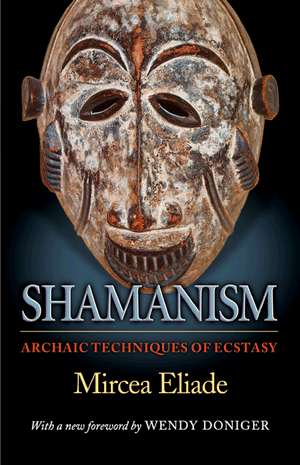 Shamanism by Eliad
 I have been reading "Shamanism: archaic techniques of ecstasy" my Mircea Eliad. After reading through the first two chapters I have been noticing that the initiatory rites of the Shamans are ecstatic dreams or visions which elements of Christ's death and resurrection, or at other times model His temptation in the wilderness.
I find some parallels of ecstatic experience in my own life. Could there be a regular prefiguration of Messianic call happening simultaneous in many cultures? I tend to think so, and this makes me wonder why the similarities of Christianity and other religions generally cause people to view Christianity as adopting Pagan practices. Could it not be possible that a single voice from the other side of this veil calls out to various cultures in similar, but culturally adapted modalities?
Okay, I suppose that was a weird, and overly complex connection. But if you are up for a great read from a fine scholar who was the world's foremost authority on Shamanism, follow the link above, and get the book.
Subscribe to:
Posts (Atom)

