Sunday, June 22, 2008

Defining Missional: a SynchroBlog

The above poster comes from http://teampyro.blogspot.com/ Obviously they are not defining missional today. ;-)

Today a large number of bloggers including some significant thinkers who spend the their days considering missional issues are releasing posts defining "Missional." Perhaps this SynchroBlog will provide an historical moment in defining this wee movement of ecclesiastical types who call themselves missional. Perhaps we will simply flap our lips in the wind of God's Spirit as it blows by. I'm hoping for something closer to the former. So I have entered the fray of missional definers, and have saddled up alongside people who think about this stuff far more than I do.

Yet, I think that I do bring some pedigree to the table of thought, and offer my expertise in relational development and evangelical networking with new religious movements (especially Neo-Pagans) as part of the art of missionality.

I am not typically fond of dealing with semantics, except as a means of defining the terms of a specific dialogue. I perhaps am even a little more uncomfortable finely outlining the edges of a word barely squeaking into my 2001 version of Webster's Unabridged Dictionary as though it was an afterthought - listed as an adjective of "mission." Words important to the integrity of a language interest me. Words newly created, or suddenly adapted to define developing movements are less interesting to me, because they are still simply pop terms. (Now, I know the word has been around since the late 19th century - at least, but that is still new as far as the life span of a language is concerned.) See Tall Skinny Kiwi's discovery of the 1883 usage of the word

Yet I will attempt the daunting task of defining a newly developing, and unsettled term simply because it is something considered by many people to be descriptive of the behaviors of our own fellowship in Salem, MA.

I would like to consider being missional as an art as I define the term. As a science, I believe it would lose its power, and its definition altogether. Missional behavior is based upon redemptive interaction with people. Dealing with the fickle human character is certainly more of an art, than a science.

If being missional somehow evades exact definition as it continues being bantered about by those of us who use the term, it may actually be finding its mark more frequently, and remain a living word than if the term becomes solidified like concrete, or codified like a law.

Yet there are distinct values which must remain intact if the word will not end up wallowing in a mire of pop usage, flowing smugly off the lips of people who are anything but missional.

So, here are my feeble attempts to do something I am not quite comfortable doing - defining a pop theological term.


Missional:

As a newly popular term describing the activities of the Christian church the word "missional" is in need of defining if it will accurately describe any movement, or activity of the Church. Perhaps this broad group of people, many whom I write with regularly on the SynchroBlog list I help lead, can by sheer force of the number of words being published online create a solid reference point for anchoring the word missional in the ecclesiological psyche. (As a small historical, but insignificant sidenote, I am the originator of the silly term "SynchroBlog")

Missional is a relatively new word, finding its first published reference in 1893 (see note on Tall Skinny Kiwi above.) In my dictionary it finds itself relegated to a mere afterthought as an adjective of the word "mission." Yet "mission" has a far broader definition that we attach to the concept of missional today. Missional does not relate to military campaigns, or the ruins of former Spanish churches on the coast of California.

The popularity of the word has been driven by the Emergent movement, and appears to be particularly popular as a personal descriptor by those who are considered to be a part of what Scott McKnight calls the Praxis Oriented Stream of Emergent in his Five Streams of the Emerging Church.

I will leave origins of the term to others who study this stuff. Discussions of its misuse will be left to others as well. I have a few thoughts which particularly resonate with me. So others will be left to the task of doing things like connecting Newbigin, and Hartenstein to the term.


ANTHROPOLOGICAL MISSIOLOGY IS AT THE HEART OF BEING MISSIONAL

At the heart of missional behavior is something I hold dear: a radical anthropological missiology.

The "glory of God" is considered by many theologians, pastors, and lay people to be the prime focus of authentic human behavior. I agree. This includes the preaching of the Gospel, and any manner of sharing our faith. Yet, I believe that focusing upon the "glory of God" in our Gospel preaching has too often incapacitated the Gospel, and left it stagnant in a world of flowing change. For the sake of glorifying God churches and church leaders have remained unbending in the culture of their denominational styles, and been unwilling to take the time to understand the culture, and the individuals surrounding them. Our vocabulary has often remained stagnant while our language has been changing in the culture around us, and our attitudes have been witness to the fact that we are part of the status quo - or so it appears to people.

Yet Christ came to serve others, and we are called to do the same. The heart of the Gospel itself is anthropocentric. The good news is about Christ, but it is for people. It is designed to relieve suffering, create healthy family structures for the abandoned, give definition of life to the lost, and bring joy to those who mourn. Christ is the reason the Gospel exists, but people are the target of its mission to bless. God's eye is upon people with a heart for blessing. This is the missio dei. People are at the center of God's heart in the Gospel, and those who will be missional must place people deep in their hearts as well, and so we are called to serve, and to study others. My heart must remain Christocentric in its worship, but the missio dei calling me to service focuses upon the fact that I am a bondservant to others.

Without becoming students of others missional behavior lapses into mere proclamation, and loses the very heart of its purpose to bless, to serve and to care.

I do not believe a person can be missional without understanding others. On an English translation site of the French website philosophie-spiritualite.com there is a wonderful outline of the common mistakes made in the process of dialogue, which cause misunderstanding or establish a less than beneficial interaction.

"Talking to somebody is not just trying to make oneself understood. Dialogue can walk astray and off the path leading to an understanding of others. 1) One may slip into mere information; in this case only the person talking understands what is being said. Exchange never takes place, yet this is required for dialogue. To have a dialogue it is not enough to find a willing listener with the patience to put up with your talking, but to whom you yourself will not be listening. 2) There can also be a misunderstanding when two people don’t attribute the same meaning to the same words, so that each one of them speaks at different levels. The common ground is then missing. 3) Dialogue can degenerate into mere chatting. Chatting appears to be a dialogue, but the people talking are not present in what they say: the content of their speech is as insignificant as it is repetitive. Speech does not aim at the other person’s understanding it; it is only there to substitute for a real presence and above all to avoid silence. A dialogue is only useful to understand others if it makes possible an intimate exchange with them. 4) A dialogue can degenerate to polemics when one wants the exchange of a dialogue, while refusing to make any effort to understand the other person’s position. Each person then sticks to his position and instead of exchanging ideas one struggles to uphold this or that conviction. Polemics replaces the confrontation of points of view by the opposition of individuals. We see this when spokesmen fire off all their weaponry to criticise a viewpoint, then retreat into muteness, and pay no attention to the objection of their adversary. 5) Dialogue also self-destroys in lying. As soon as lying makes its way into the dialogue, speech loses its true purpose. There can be no comprehension without truthfulness and without a genuine intention to have a dialogue. Have can we understand one another if we are not sincere?" (from lesson 12)

Missional behavior demands seeking to understand the perspective, the feelings, the thoughts of others, and learning to present the good works of God, and the preaching of the Gospel in a manner identifying with the needs, the concerns, and the pains of those we serve.

There is a power in the subjectivity which attends the empathetic individual following the missio dei. It is something we might call a subjective imagination. Our experiences have given us a sense of dread or a sense of liberation, a sense of mourning or a sense of child-like joy, a peace or a deep seated anxiety; and these feelings which we have experienced can be imagined to belong to another. The things we have felt, and feared can be superimposed upon the framework of our thinking about other people, and we can see them as fellow sufferers on this life journey, or we can coldly consider their actions in the light of a set of legal standards.

This subjective imagination allows us to empathize with others, and thereby live incarnationally. As Jesus, Who lived in our shoes, and experienced our woes became the perfect High Priest understanding our every struggle, so we too can express the love of God through identifying with the sorrows, the temptations, and the struggles of others.

Missional activity is less than missional without this subjective imagination, which imposes compassion upon others in their difficulties. Whether we are dealing with cultures or individuals, we are called by the missio dei to serve people in their suffering.


MISSIONAL ACTIVITY TRANSCENDS CULTURE

The Gospel of Christ transcends human culture and thought. It is not stuck in the 19th century, nor is it married to post-modernity. It is good news to the conservative and the liberal, the socialist and the capitalist, the cultural Christian and the new Pagan, the fundamentalist and the anarchist. It was not limited by the fact that Matthew was a Tax Collector, and Judas (not Iscariot) was a radical anti-establishment zealot. They were brought together by the Gospel. It was not limited in them, and it is not subject to human foibles now.

Similarly, the Kingdom of God critiques each and every human culture. Republicans and Democrats in America are evenly critiqued by the upside-down nature of God's Kingdom. Those who have the freedom to drink, and those who are teetotalers are equally challenged to walk in love toward others. The devout and the apathetic find themselves both corrected by the voice of God, and this is the manner of the Kingdom.

Missional followers of Christ will walk between worlds at odds with one another. Missional followers become peacemakers between extremes, and evidence that they are the sons of God. We will dance in the combat zone between the warring factions of our society, and live like fools for Christ's sake. Our battles are not the battles of this world, and at what time we are called to take up a cause, that cause is still subordinate to the missio dei gently hovering over us.

Just as it is not constrained by culture, missional activity is not constrained by church facilities. In American church culture church buildings have often become a bane to evangelistic activity in the life of the local church. Focusing our attention upon buildings we have omitted the command to "Go and preach the Gospel."

Yet just as buildings are not needed to proclaim the good news of the Kingdom, The Gospel is not constrained by the use of a building. Churches are creating Going Experiences with creative use of buildings, and others are creating Going Experiences through creative methods of stepping outside a building. Just as the missio dei transcends the cultures of our world, it also transcends the use of buildings - it can be accomplished within or without the building,

Denominations, specific and non-essential details of theology, styles of worship, liturgical practices, social programs, styles of communication, and ecclesiastical structures are not constraining factors for the missio dei. At one moment they may become a hindrance, yet at another moment they may become a tool for the Gospel.

Understanding this cultural transcendence of the Gospel is necessary for those who will live a missional life.


These are my quickly gathered thoughts to the question, "What is Missional?" I certainly have not presented anything authoritative. These are simply the conjectures of someone who has spent the last 10 years breaking down walls of communication, which have been erected between Neo-Pagans and Evangelical Christians, and my observations about being missional are based upon just a couple (among many) things which have been necessary in my own experience.

Please check out some of the other 49 writers on the following list. I am sure you will be blessed.

Saturday, June 21, 2008

Missional SynchroBlog on Monday

Rick Meigs of the "Friends of Missional," and "Blind Beggar" fame has called for a SynchroBlog on the subject "What is Missional?" So I've decided to enter the fray, and post my thoughts. There are 50 bloggers on the list, making this a daunting task to read through.

As you scroll down the list, which is in alphabetical order by first name, you will find a significant number of heavy hitters in the emergent, and missional discussion. Of course, I have taken my own name and placed it at the top. If you are on this list, and you are copying the link list from me I encourage you to take your own name, place it at the top, and then provide the direct link to your post, rather than a generic link to your site.

So join us on Monday, June 23rd, 2008 for the "What is Missional?" SynchroBlog. Here's the gang who will be posting on that day:

Phil Wyman
Alan Hirsch
Alan Knox
Andrew Jones
Barb Peters
Bill Kinnon
Brad Brisco
Brad Grinnen
Brad Sargent
Brother Maynard
Bryan Riley
Chad Brooks
Chris Wignall
Cobus Van Wyngaard
Dave DeVries
David Best
David Fitch
David Wierzbicki
DoSi
Doug Jones
Duncan McFadzean
Erika Haub
Grace
Jamie Arpin-Ricci
Jeff McQuilkin
John Smulo
Jonathan Brink
JR Rozko
Kathy Escobar
Len Hjalmarson
Makeesha Fisher
Malcolm Lanham
Mark Berry
Mark Petersen
Mark Priddy
Michael Crane
Michael Stewart
Nick Loyd
Patrick Oden
Peggy Brown
Richard Pool
Rick Meigs
Rob Robinson
Ron Cole
Scott Marshall
Sonja Andrews
Stephen Shields
Steve Hayes
Tim Thompson
Thom Turner

Wednesday, June 18, 2008

Is it All About the Green?: A Skeptics call to Environmental Action

This is part of this month's Synchroblog about Green Spirituality.


I have an uncomfortable alliance with Green Christianity. On the one hand I do not believe that we are doing enough, on the other hand I do not really believe the threatening science of global warming.

I believe it is humanity's necessary task to care for the earth, and in these current days we need to leave it in better shape that we found it for our children's sake.

Yet, I tend to feel that the current threatening dialogue of global warming falls into being all about the green, and I don't mean leaves, and grass. I can not help but wonder if 10 years down the line we will have made millionaires out of people on the forefront of the global warming crisis, and will rethink the science to move on to another crisis, which will once again consume our personal finances in the name of caring.

I can say these things. We drive a Prius. We recycle plastic, paper, glass and aluminum. We have a composter in the yard. I have water barrels adorning the back of my house. Our church sponsored the speakers for Salem's Living Green and Renewable Energy Fair and hope to do so again next year.

For myself as well, I suppose that conservation is greatly about the green, and I do mean money green. If it can be cheaper, and help the environment I like it - thus I am ambivalent about my wife's choice of the Prius, and prefer my old diesels, but I am afraid that the current trends in ecologically friendly resources are all about making expensive things, which make the rich richer, the mid-classes who can afford to go green poorer, and the poor will have the last bit of green sucked from them.

I hope I am wrong, but let's look back at this post in ten years, and we'll see.

I will recycle. I will drive a Prius. I will make compost, and finish setting up those water barrels in the backyard. More will follow. I think that I might make biodiesel and cut my heating fuel with 20% biodiesel. I might want to build a wind generated power plant for the house from local hardware store parts. (Notice how I avoided saying mentioning the orange guys.)

I may not be alone in this thinking. Even among those who are fully convinced that global warming is coming.

Well, that is my heretical thinking on the subject. But even if I am a skeptic no one can accuse me of not doing anything about the problem. One way or another I suppose it will end up being all about the green. I hope I can help keep some green in the pockets of the poor, as well as on the earth as we move through the coming years of threatening science.

Wanna read about the scientists who reject the current global warming mania? Check out The Deniers. I haven't read the book yet, but I followed many of the articles which eventually came together to develop the book, and it is significantly impressive enough to consider methinks.

But don't let skepticism about global warming make you inconsiderate about the earth you have been called to care for.

Tomorrow's SynchroBlog on Green Spirituality

Tomorrow there are a small handful of us posting a SynchroBlog on Green Spirituality. The posts may not be up and running until Thursday afternoon, but here is the list as I have it so far of the other bloggers:

Is it All About the Green? by Phil Wyman
Rediscovering Humanity's Primal Commission by Adam Gonnerman
Turn or Burn? A New Liberal Hell? by Cobus van Wyngaard
Little Green Man by Sonja Andrews
Bashing SUV's for Jesus by David Fisher
Saints and Animals by Steve Hayes
When Christians Weasel Out of Their Environmental Responsibilities by KW Leslie
Green Christian Manifesto by Matt Stone
God So Loved by Sally Coleman

Saturday, June 14, 2008

Big Waves


Tonight we were showing a movie called "Riding Giants" at The Gathering.

A group of four high school guys from Swampscott hung out with us for awhile. They found me playing my guitar out in front of the church, and I played them my Welsh song which I am writing, because one of them had a Notre Dame Fighting Irish shirt on and was into Celtic things. They loved the Welsh song, and decided to come in and watch the movie with us.

An old surfer who spent some time surfing Rincon years ago, came back for a second week of surf movie night, and a few others just dropped in as well.

After the event was over, and Carlos, Chris, Jim, Erin, and I made a few new friends, I walked home, and stopped at the Salem Outpouring meeting for a few minutes. This meeting is connected to the Lakeland revival in a roundabout manner.

Maybe I am simply to worldly, but I was having far more fun watching "Riding Giants," and getting to know some of the people in our community who don't like churchy things, than I was at the revival meeting. Was I missing one big wave to simply watch another?

My short encounter with the revival meeting is posted here.

Monday, June 09, 2008

Pentecost and the Way of the Shaman


shaman
Originally uploaded by M & G
I wrote this article some time back, but it has been sitting in a competition pile, and made the cut of winners in the culture category at the website Jesus Manifesto. Go ahead and follow the link to read it, and even post a comment at Jesus Manifesto if you like it. Heck, post an article if you want to berate it.

direct link to full article

Tuesday, June 03, 2008

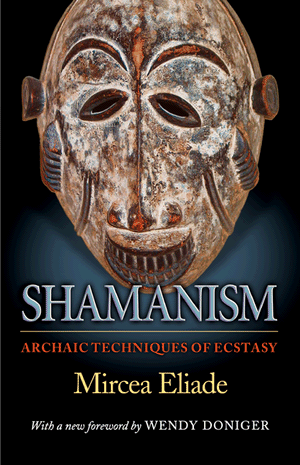
My Latest Read - on Shamanism by Eliad

Shamanism by EliadI have been reading "Shamanism: archaic techniques of ecstasy" my Mircea Eliad. After reading through the first two chapters I have been noticing that the initiatory rites of the Shamans are ecstatic dreams or visions which elements of Christ's death and resurrection, or at other times model His temptation in the wilderness.

I find some parallels of ecstatic experience in my own life. Could there be a regular prefiguration of Messianic call happening simultaneous in many cultures? I tend to think so, and this makes me wonder why the similarities of Christianity and other religions generally cause people to view Christianity as adopting Pagan practices. Could it not be possible that a single voice from the other side of this veil calls out to various cultures in similar, but culturally adapted modalities?

Okay, I suppose that was a weird, and overly complex connection. But if you are up for a great read from a fine scholar who was the world's foremost authority on Shamanism, follow the link above, and get the book.

Saturday, May 24, 2008

Our Next Thing at The Gathering

I've not been able to be very active with my blogging lately. Besides working in the mornings at a group home for kids, tearing apart about 16 tons of safety deposit boxes in the old vault at our gathering place, here is something else I've been preparing for:

Thursday, May 15, 2008

Monks to Iraq

Bloggers UniteToday I was watching C-Span. A group of soldiers who had spent some years in Iraq were telling of atrocities perpetrated during the current war.

Two days ago I sat with a new friend - Geoffrey Ames. Geoff is a Bishop for a small evangelical Orthodox Church group here in America. Geoff is a Franciscan monk, and spent a few years developing a Franciscan mission community in a town nearby. Geoff is also a weekend warrior. He is in the Army Reserves, and has been called to Iraq. This will be Geoff's second tour of duty.

Yes, Geoff is a Franciscan soldier - hmmmmmm. That must blow your mind. I know that it certainly does that for many other people. Geoffrey will be a chaplain's assistant. He will carry a gun. He spoke of his first tour of duty, and is excited to go back. Recently he has been teaching school, but wanted to have more freedom to share his faith. Being called to Iraq offers that opportunity.

Geoff told me stories about helping children in Iraq, and how the soldiers he knew really cared to help the Iraqi people. He told of times the Iraqi people expressed their appreciation for the American presence.

Geoff left his car with us, and we will have it in our care for the year (perhaps more) while he is away.

I am deeply impressed with the devotion of my new friend Bishop Ames the Franciscan monk. I will be praying for him, and shoring his stories with our church. I am not sure how his story informs my thoughts about the war, and my concerns for justice and human rights. I am convinced that Franciscans devoted to peace placing themselves in the heart of the war zone is a Gospel thing. I am also convinced that war is a serious transgression against the rights of those who are touched by that war.

I drove brother Geoff's car today, and considered these issues. War is wrong, but brother Geoff is one of my heroes. I am glad God is sending Franciscan monks to Iraq.

Other SynchroBloggers on this subject:


  • Phil Wyman on href="http://squarenomore.blogspot.com/2008/05/monks-to-iraq.html" target="_blank">Monks to Iraq.

  • Adam Gonnerman on href="http://igneousquill.blogspot.com/2008/05/may-synchroblogbloggers-
    unite.html" target="_blank">Guantanamo Bay in the eyes of God
    .

  • Julie Clawson on Human rights and Christian
    comfort
    .

  • Steve Hayes on Human rights and Christian faith.

  • Steve Hayes (again!) on href="http://khanya.wordpress.com/2008/05/15/human-rights-and-amnesty-
    international/" target="_blank">Human Rights and Amnesty
    International
    .

  • Alan Knox on My charade is the event of the
    season
    .

  • Sally Coleman on href="http://sallysjourney.typepad.com/sallys_journey/2008/05/if--bloggers-
    un.html" target="_blank">If.

  • Sonja Andrews on target="_blank">Human wrongs.

  • Cobus van Wyngaard on href="http://mycontemplations.wordpress.com/2008/05/15/christianization-and-
    humanization-and-our-task-in-zimbabwe/" target="_blank">Christianization
    and Humanization and our task in Zimbabwe
    .

  • Janice Fowler on href="http://gracexpectations.blogspot.com/2008/05/voice-overs-needed-or-wake-
    up-speak-up.html" target="_blank">"Voice overs needed" (oe "Wake up --
    speak up")
    .

  • Bryan Riley on href="http://charisshalom.fjministries.com/2008/05/15/bloggers-unite-for-
    human-rights/" target="_blank">Bloggers unite for human
    rights
    .


Friday, May 02, 2008

Social Action and Pentecost: non-verbal expressions of our faith

And I, brethren, when I came to you, did not come with excellence of speech or of wisdom declaring to you the testimony of God. For I determined not to know anything among you except Jesus Christ and Him crucified. I was with you in weakness, in fear, and in much trembling. And my speech and my preaching were not with persuasive words of human wisdom, but in demonstration of the Spirit and of power, that your faith should not be in the wisdom of men but in the power of God. (1 Corinthians 2:1-5)

The Franciscan call says, "Preach the Gospel. When necessary use words." The heart of Christian social action is found in this dictum. God's care for the world should be expressed by His people in acts of mercy and giving. The poor should be cared for, and the oppressed relieved. These actions often speak louder than words, and carry the seed of the Gospel in them.

In comparison evangelical and Pentecostal Christianity sometimes look (and sound) shallow, and pompous next to taking serious social action. Of course Christians should be involved with caring for the impoverished and oppressed of the world, but I wonder if the above words of the Apostle Paul are the connecting dots between social action and Pentecostal faith.

His Gospel, perhaps like that of Francis of Asissi, was not simply spoken, but illustrated. Paul healed the sick and cast out demons. He demonstrated God's power through his prayers and blessings to the impoverished and the oppressed, and he did so in such a way as to emphasize his own weakness. By this he more perfectly illustrated the Gospel - He clearly modeled salvation as an act of God's power moving upon humans despite their incapacity to save themselves.

Healing and deliverance through the miraculous acts of the Spirit of God are still the greatest social action moments of the Biblical narrative. They do not by any means give Christians the right to ignore caring for the poor and oppressed in practical ways, but our knowledge of God's power should cause us to desire the spiritual gifts and move into a wholly new realm of social action.

Saturday, April 26, 2008

Power to Bless?


“James and John saw this, they said, "Lord, do You want us to command fire to come down from heaven and consume them, just as Elijah did?"
But He turned and rebuked them, and said, "You do not know what manner of spirit you are of. For the Son of Man did not come to destroy men's lives but to save them." And they went to another village.”
(Luke 9:54-56)


It seems to me that the power of Pentecost (that fire and wind event, which stands out as the prime example of God's power working in and through Jesus' followers, and becomes both a model we look back to, and an experience we hope to discover for ourselves) has a central motivating factor which is so simple that we overlook it.

The power of Pentecost seems to be that of granting blessing.

Jesus was none too happy with the "sons of thunder" who wanted to call fire down upon those who rejected the message of Christ. Though Peter had to call the young men to carry Ananias' and wife's bodies out of the house, this was not the common power motif of the book of Acts. The few instances of power judgments appear to be the exception and not the rule. The stories of healing and deliverance far outstrip the stories of power judgments in the New Testament, and any general reference to power encounters in the New Testament do not mention judgments, but always blessing.

I have heard a great many prophecies of judgment during my 28 years as a Christian. I have not seen these judgment prophecies come true - at least not with any accuracy beyond that which monkeys playing the stock market would achieve. I would think that if we see judgment as a power play by God during these current days that we like James and John have misunderstood the "manner of spirit [we ] are of."

Tuesday, April 15, 2008

Salem: No Place for Hating Witches - SynchroBlog for April 16th, 2008

I am able to take a little time and write this because I completed my taxes months ago.

I really wanted to get away from posting about Neo-Paganism. Yes, I live in Salem, and Witches, Wiccans, Pagans, and the like are the common fare of local experience. Yes, this is home to such groups as The Witchcraft League for Public Awareness, and yes, I do specifically have understanding about the goings-on in the Pagan community because of friendships I have developed over the years, but nonetheless one wishes to write about something else once in a while, but alas recent events have conspired to make this SynchroBlog on the subject of social justice, and the topic of Neo-Paganism blend into one.

On Saturday, April 12th Jerrie Hildebrand and Salem's No Place for Hate Committee organized a panel discussion featuring Jerrie (a Salem Witch and social activist), Salem State professor Elizabeth Duclos-Orsello, and Margot Adler: the host of NPR's "Justice Talking" and a famed Pagan author.

The focus of the public discussion was to highlight Wiccan/Pagan lifestyle and beliefs in order to break misguided public perceptions, and help bring healing and understanding to the community.

So, here is why I need to write about this in my SynchroBlog on Social Activism and Christian Mission - Our church supplied the sound system, and I ran the sound for the event.

An article in Salem News from Monday the 14th highlights this event.

The newspaper seemed to underestimate the crowd from my evaluation. It seemed that there were closer to 100 in the room, which seats about 220, and the Pagan population appeared to be a little more than half the group when hands were raised.

Margot and Jerrie gave a brief history of Neo-Paganism in the US, and in Salem specifically. After about an hour, questions were asked, and the Salem State professor monitored the questions.

Here are some of the statements, and questions which stood out to me during the evening:

Jerrie: "We are single, married, monogamous, with multiple partners, gay, heterosexual, and from every walk of life." That did define the room itself, and the Pagan community as I have come to know it over the years.

Margot: "People are not comfortable talking about religion. After 35 years I can count on two hands the number of people who have asked me to coffee in order to sit down and talk about what I believe." I later asked her if I could come down to new York City sometime and meet her over coffee (I did not mention I hate coffee), to talk about Paganism with her.

The newspaper article outlines some of the questions asked, and points of discussion, and covers the basics of the meeting. My point for writing this is something different altogether: What is the place of the church in creating peaceful discussion with other religious groups?

Reading the comments to the Salem News article one finds what appear to be rather mean spirited comments from Christians. I responded with an apology for the behavior of the those from my tribe who are supposed to be "peacemakers."

Is there a place for social activism to include Christians getting involved in anti-hate campaigns against religious groups with which we theologically disagree on fundamental points of doctrine and truth?

I say yes, and have received not a small portion of condemnation for it.

What do you say?

Monday, April 14, 2008

Social Activism and Christian Mission SynchroBlog - April 16th

Here are the list of socially concerned, and maybe even active individuals who are going to be blogging together on this subject Wednesday, April 16th:

Phil Wyman at Square No More - Salem: No Place for Hating Witches
Mike Bursell at Mike's Musings
Bryan Riley at at Charis Shalom
Steve Hayes writes about Khanya: Christianity and social justice
Reba Baskett at In Reba's World
Prof Carlos Z. with Ramblings from a Sociologist
Cobus van Wyngaard at My Contemplations: David Bosch, Public Theology, Social Justic
Cindy Harvey at Tracking the Edge
Alan Knox at The Assembling of the Church
Matthew Stone at Matt Stone Journeys in Between
John Smulo at JohnSmulo.com
Sonja Andrews at Calacirian
Lainie Petersen at Headspace
KW Leslie: Shine: not let it shine
Stephanie Moulton at Faith and the Environment Collide
Julie Clawson at One Hand Clapping
Steve Hollinghurst at On Earth as in Heaven
Sam Norton at Elizaphanian: Tesco is a Big Red Herring
Kieran Conroy at Wrestling with Angels

Friday, April 04, 2008

SynchroBlog - Social Activism and Christian Mission

Would you like to join the growing list of people involved in our SynchroBlog (see the original post here)? This month the topic is Social Activism and Christian Mission. Let me know if you want in, or check out the SynchroBlog e-mail list here. Release date for this blog is Wednesday, April 16th.

Monday, March 17, 2008

Pub Theology #2

For more info on the tomorrow's Pub Theology check out The Gathering's Blog.

Wednesday, March 12, 2008

SynchroBlog on Neo-Monasticism

I am not a neo-monastic. I do not have much experience with neo-monasticism. I've been to Taize and thought it was powerful, and cool. I've spent a little time with Karen Sloan and some of the Presbymergent gang which includes a few neo-monastics. I know Beth (our guest blogger on this subject) who has her little community which some consider a neo-monastic community, but I really don't know much about neo-monasticism. I do think that it is a great concept, at least what I know, or perceive of it.

I perceive it as a community of mission minded Christians, who live and worship together, and find ways to impact their neighborhoods - a simple definition. I wonder - Need it be more?

Beyond that, I wonder if my evangelical/Pentecostal background has neglected this potential for too long. Is it possible that there are people who currently appear to be strange in the eyes of many Christians, who would be powerful expressions of the faith if they were placed in devoted communities of the faith, and given the potential for living in radical mission to their cities?

Links to SynchroBlog on Neo-Monasticism

Here is the list of those Blogging on the subject of Neo-Monasticism for this month's SynchroBlog. Welcome to March: the month of Dewi San (Saint David of Wales), and Saint Patrick. Neo-Monasticism seemed like a great subject when suggested by Steve Hayes in South Africa. Our special guest Beth at Until Translucent has specific and direct knowledge of this topic - check out her post when it comes up, and the others as well. Release date is Thursday the 13th, but here in the Americas I suggesting the posts be posted tonight - Wednesday night March 12th.

Phil Wyman at Phil Wyman's Square No More
Beth at Until Translucent
Adam Gonnerman at Igneous Quill
Steve Hayes at Notes from the Underground
Jonathan Brink at JonathanBrink.com

Sally Coleman at Eternal Echoes
Bryan Riley at at Charis Shalom"
Cobus van Wyngaard at My Contemplations
Mike Bursell at Mike's Musings
David Fisher at Cosmic Collisions
Alan Knox at The Assembling of the Church
Sam Norton at Elizaphanian
Erin Word at Decompressing Faith
Sonja Andrews at Calacirian

Tuesday, March 11, 2008

Repent America Street Preacher Found Guilty in Salem

Each of the last four years (actually it seems like more, but that's what the paper says) Michael Marcavage and his friends come to Salem to hold big signs, and preach through bullhorns on and just before Halloween. In the Salem News today there is story about Michael being found guilty.

Our church has a little history with Michael. He had some things to say about us in a recent article in Salem's other paper The Salem Gazette.

Here is Repent America's video taken during the arrest on Halloween:


Now, I have some distinct feelings about this issue, and will simply say a few things related the subject, which might help shed some light on the subject from a local pastor's point of view.

1. Repent America is not supported by any of the local churches in their activities here in Salem. I am not even aware of a local church which appreciates their activities (I suppose there may be one, but I am not aware of any.)

2. Over the last number of years I have known street performers, and people barking for events who have been asked to stop using amplification, and even stop working prior to the 10pm curfew set against such noise. Noise ordinances, public complaints, and crowd unruliness during Halloween night have all been reasons for the police request to stop. Preachers have NOT been the only individuals requested to stop.

3. Every year our church is the single largest Christian presence on the street during the month long Halloween season. We obey every request of the police, and if something unique pops up, we resolve the situation with the help of city officials before we resume our activities. Despite working with the police in this manner, we find that people stand in line for up to an hour to experience our events, and despite the fact that we do not emphasize making a decision to receive Jesus, we see between 30 and 40 people make that decision each year, because they ask how to get closer to God. (This is not information I have shared at any time before, because we are sensitive to the fact that Evangelical Christianity looks like it is FORCING conversion upon people, and we never want to be guilty of that heinous crime against nature - even though we are evangelical.)

4. Our people have been asked by the Pagan community to be protected from these same street preachers, and we went out to bring peace on the streets.

So, what do you think? Does taking away a bullhorn amount to restricting free speech?

Monday, March 10, 2008

UK Radio Interview Online Now

The radio show Premier Drive, which I was asked to speak on a couple weeks ago sent me the audio file of the interview. The show was an interview about the Witches in Salem, and the Christian community living here. I've downloaded the file onto The Gathering at Salem Website.

You'll find a link to the podcast of the show on the front page of our church website.

Check it out and let me know what you think.

Sunday, March 09, 2008

Upcoming SynchroBlog on Neo-Monasticism - Thursday, March 13th

If you want to join the March edition of the SynchroBlog please inform me. This month the topic is Neo-Monasticism, and we will have Beth joining in on this one. Steve Hayes from South Africa suggested the topic - thanks Steve.

The above link to the SynchroBlog will give you an idea of how it works. I intiated this idea a little over a year ago to find friends who loved the same wacky topics as myself, and to take over the world with our ideas! Okay so much for taking over the world, but at least we can debate, argue, and throw beer bottles across the oceans at each other in fun. The release date for the blog is this coming Thursday, March 13th. I encourage all on the American continent to release it by Wednesday evening so that we can keep up with our friends from around the globe.